Open the App Store page for your bank's mobile app and read the last twenty reviews. Half of them will complain about the same thing — a login that loops, a check deposit that fails on the third try, a push notification for a payment you already made yesterday. Now open your bank's own website and look at the "modern" online portal that's supposed to do everything the app does. It's a different product, maintained by a different team, and it usually shows.
That gap is where the real mobile banking apps vs traditional banks comparison lives in 2026. Not "app vs branch" — that framing is dead. Every traditional bank has an app now. The question is whether the app is actually good, whether it costs you money through hidden fees, and whether the branch network you're paying for is a feature or dead weight.
Key Takeaways
- Traditional banks and mobile-first banks now compete on app quality and fee structure, not physical presence alone.
- Monthly maintenance fees at big traditional banks often run $10–$15, waivable only if you keep a minimum balance or set up direct deposit.
- Mobile-first banks typically pay higher savings rates but offer no cash deposits and thinner customer service hours.
- The real divide isn't "mobile vs traditional" — it's app-first design vs app-as-an-afterthought, which cuts across both categories.
- A hybrid setup (one account for cash and in-person needs, one for savings and daily spending) is what most people I know actually end up with.
- Your own spending pattern — how often you touch cash, how much you save, how often you call support — decides this better than any feature checklist.
Is mobile banking apps vs traditional banks still a real comparison?
Not in the way most people assume. The line between the two has blurred to the point where it's almost misleading.
Chase, Bank of America, Wells Fargo, and Citi all ship apps that rival dedicated neobanks on core features: mobile check deposit, real-time card freezing, Zelle transfers, virtual card numbers, spending breakdowns by category. Meanwhile, "online-only" banks like Ally and Capital One 360 run branchless models but still offer ATM networks and sometimes physical cash access through partner machines.
The honest comparison today is three-way, not two-way:
- Traditional banks with mature apps (Chase, BofA, Citi) — full branch network, robust app, higher fees
- Traditional banks with weak apps (many regional and community banks) — branches plus a portal that feels like it was designed in 2014
- Mobile-first banks (Chime, Revolut, Monzo, N26) — slick apps, no branches, variable fee and rate structures
I used to assume "traditional bank" meant "slow app." Then I watched a friend run her entire freelance business through the Chase app for a year without ever walking into a branch. She deposits checks by photo, splits invoices through Zelle, and calls the branch exactly twice — both times about a wire transfer she couldn't initiate from the app.
So the framing needs to shift. You're not choosing between mobile and traditional. You're choosing which combination of app quality, fee structure, and physical fallback fits how you actually move money today.
What actually separates the two in 2026
Four things matter, and the rest is marketing noise:
- Where your money physically sits and what it's insured under
- What you pay to hold an account (monthly fees, overdraft charges, ATM fees, foreign transaction fees)
- What the app can do without forcing you into a branch or a phone call
- How fast you can reach a human when something breaks
Everything else — the colors, the "financial wellness" dashboards, the cashback offers — sits downstream of those four.
What are the key differences between mobile banking and traditional banking?
The differences aren't about what you can do anymore. They're about cost structure, access, and how fast problems get solved.
The fee structure gap is bigger than you think
Traditional banks carry overhead that mobile-first banks don't: real estate, in-person staff, armored car logistics, branch renovation cycles. That cost has to come from somewhere, and mostly it comes from monthly maintenance fees and minimum balance requirements.
A typical big-bank checking account runs $10–$15 monthly, waivable if you maintain a $1,500 balance or receive direct deposits of a certain size. That looks harmless until you do the math: $12 a month is $144 a year for the privilege of holding your own money. Overdraft fees, meanwhile, have been squeezed in recent years — several large banks now cap them or eliminate them outright — but they haven't vanished everywhere.
Mobile-first banks flip the model. No maintenance fees, no minimums, and often higher yields on savings. The trade-off: you give up physical branches, you often can't deposit cash without a workaround (Walmart or Walgreens partnerships in some cases), and customer support happens through chat rather than a person behind a desk.
Access to your money looks different in practice
Here's a scenario that plays out constantly. You receive a physical check from a contractor, a rebate, or a family member. With a traditional bank, you walk in, hand it over, and the money hits your account — sometimes instantly, sometimes after a hold depending on the amount. With a mobile-first bank, you photograph it through the app and wait. That wait can be one business day, or it can be five if the amount crosses a threshold.
Same situation, different friction. Which one annoys you more is personal.
Customer service is where the real split shows up
Mobile-first banks have improved dramatically. Their chat support is fast, in-app, and often solves simple problems in under five minutes. But when something goes genuinely wrong — a fraudulent wire, a frozen account, a dispute that needs a human with authority — the branch network still wins. You can walk into a Chase, sit down with a banker, and have the problem escalated in person. That's hard to replicate over chat.
The trade-off isn't "good vs bad service." It's "fast for routine, thin for edge cases" versus "slow for routine, solid for edge cases."
Is online banking better than traditional banking?
For most everyday transactions, yes. For everything else, it depends entirely on what you're trying to do.
If your financial life is direct deposits, card spending, digital transfers, and occasional check deposits, online-only banks win on cost and speed. You pay less, you earn more on savings, and your app is usually better designed because it's the entire product — not a side panel bolted onto a branch operation.
If your financial life includes cash, in-person deposits, cashier's checks, safe deposit boxes, notary services, or complex disputes, traditional banks win. You're paying for access, and sometimes that access is worth the monthly fee.
I ran an experiment two years ago: moved my primary checking to a mobile-first bank, kept a small traditional account open for cash and in-person needs. Total monthly cost dropped by roughly $11. But the number of times I genuinely needed the branch over that period was small — maybe four visits in eighteen months. Three of those were for a cashier's check. One was to sort out a fraudulent charge that the mobile bank couldn't resolve quickly enough.
So was online better? For my daily spending, absolutely. For my edge cases, no.
What is traditional banking, in practical terms?
A traditional bank is an institution with physical branches, in-person staff, and a regulated deposit-taking license — typically FDIC-insured in the US, or covered by an equivalent national scheme elsewhere. It offers checking, savings, loans, mortgages, and often business banking under one roof. The app is one channel among several, not the whole business.
The important part: traditional banks are held to the same deposit insurance rules as mobile-first banks that partner with them. When a neobank says "your funds are FDIC-insured," it usually means the money sits in a partner bank's account, which carries the insurance. That's a real distinction worth understanding, because it determines what happens if the neobank itself shuts down.
What is the major difference between online banks and traditional banks?
Cost structure and physical presence. Online banks skip branches, so their operating costs are lower, which usually translates into higher savings rates, no maintenance fees, and cheaper transfers. Traditional banks carry the branch network, so their costs are higher, which shows up as monthly fees, minimum balance requirements, and lower savings yields on standard accounts.
Everything else — insurance, regulation, mobile app presence — has converged. Both worlds now offer apps. Both are insured. Both move money digitally. The structural cost difference is what remains.
Is mobile banking better than online banking?
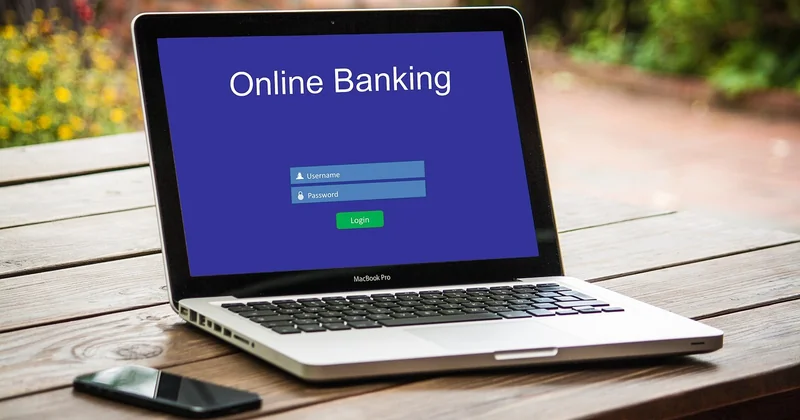
This one trips people up because the terms overlap. Mobile banking is the app on your phone. Online banking is the web portal on a desktop or laptop. They're usually the same account, just different interfaces — and in many banks, they're built by different teams, which is why the experience feels inconsistent.
Here's the pattern I've noticed across every bank I've used:
| Feature | Mobile app | Web portal |
|---|---|---|
| Mobile check deposit | Camera-based, fast, sometimes auto-detects the check | Usually unavailable, or requires a scan |
| Card freeze/unfreeze | One tap | Buried in a settings menu, sometimes impossible |
| Push notifications | Real-time, per-transaction | Email only, delayed |
| Biometric login | Face ID / fingerprint / passkey | Password + 2FA |
| Detailed statements and exports | Limited, awkward to filter | Full-featured, Excel/CSV download |
| Wire transfers and complex tasks | Often restricted or unavailable | Full support |
| Account aggregation (multiple banks) | Common | Rare, often broken |
The mobile app wins on daily actions. The web portal wins on anything that requires reading carefully, exporting data, or dealing with large sums. I still log into the web portal to reconcile expenses at tax time — the app's filters are too shallow for that.
So the honest answer: mobile banking is better for speed and immediacy. Online banking on desktop is better for depth and complexity. They aren't competitors. They're two halves of the same relationship, and the best banks get that and design accordingly.
The features that actually matter on mobile
Not all features are equal, and the app store ratings don't reflect this well. From years of use, the ones I'd actually pay for:
- Instant freeze and unfreeze on your physical card, with a separate toggle for online-only transactions
- Virtual card numbers you can generate for one-off subscriptions
- Real-time push notifications for every transaction, not just the big ones
- Mobile check deposit with clear hold-time estimates upfront
- Multi-account aggregation so you don't need four separate apps open
- Zelle or an equivalent instant-transfer rail built in, not bolted on
Features that look good in a demo but rarely matter: cashback offers on specific merchants, "financial wellness" scores, gamified savings challenges. They don't move the needle on whether the app is a good place to keep your money.
The hybrid setup isn't a cop-out
Every advice column ends with "keep both." That used to bother me — it felt like a refusal to commit. Then I realized it's just accurate. Banking isn't a lifestyle choice. It's infrastructure, and infrastructure benefits from redundancy.
What I actually run in 2026: one mobile-first account for daily spending and savings (better rates, cleaner app, no monthly fee), one traditional account holding a modest balance to keep the branch relationship alive (cashier's checks, cash deposits, emergency wire capability), and a shared savings pot with my partner through a third app because neither of the first two handles joint goals well.
Three institutions. Zero monthly fees on two of them. The traditional account costs $12 a month, which I've decided is worth it for the branch access I use roughly once per quarter. Every few months I re-evaluate. So far, it's still worth it.
The comparison between mobile banking apps and traditional banks isn't really a competition with a winner. It's a decision about which friction you can tolerate — the wait times and thin support of app-first banking, or the fees and legacy design of branch-based banking. Neither is right for everyone. Both are right for most people, in different proportions.
The measure that matters: pick whichever account doesn't make you check the app store reviews before you log in.