
Your car won't start. The transmission shop quotes you $1,800. Rent is due in nine days, and your checking account has $340 in it.
That's not a hypothetical. That's the exact Tuesday morning a reader emailed me about two years ago, and it's the reason I stopped treating "build an emergency fund" as generic advice and started treating it as a math problem. When you're on a low income, the standard "save three to six months of expenses" line isn't motivating. It's paralyzing. You do the math, realize you'd need five figures, and quietly decide the whole thing isn't for people like you.
It is for you. It just looks different. Here's how to build an emergency fund on a low income without pretending your budget has slack it doesn't have.
Key Takeaways
- Your first target isn't three months of expenses — it's $500, enough to stop a flat tire from becoming a payday loan.
- The 3-6-9 rule is a ceiling, not a starting line. On a low income, aim for the lowest number first and upgrade later.
- Automate $10-20 transfers on payday. You can't spend money you never see.
- One-time windfalls — tax refunds, sold furniture, a bonus — are your fastest path to a real cushion.
- Saving and paying down debt at the same time is fine. Stopping all savings to kill debt is how people end up back in debt.
What is an emergency fund, and why low income changes everything
An emergency fund is money set aside for genuine surprises: a job loss, a medical bill, a car repair, a broken fridge. The reason it matters more when you earn less isn't obvious at first glance. It's not just that you have less margin. It's that a small shock does disproportionate damage.
If you make $80,000 a year and your car dies, you absorb it. If you make $28,000 and your car dies, you miss work. Miss enough work and you lose the job. Lose the job and you lose the apartment. One $1,800 repair can cascade into a full financial reset — and that cascade is what an emergency fund is designed to interrupt.
Here's the thing most articles skip: the target amount is not the same for everyone, and the "3 to 6 months" figure assumes a budget with room to save. Yours probably doesn't have that room yet. So you build the fund in layers.
The three-layer approach
I first tried to explain emergency savings to a friend who was working two part-time jobs and netting about $2,100 a month. I told her to save three months of expenses — roughly $6,000. She laughed. Fair. So we rebuilt it in layers instead, and I've used this structure ever since:
- Layer 1 — the $500 starter fund. This covers the most common "emergencies" that actually happen: a tire, a copay, a utility shutoff notice. It takes most people three to five months on a tight budget.
- Layer 2 — one month of bare-bones expenses. Not your full lifestyle. Rent, food, transport, minimum debt payments. For a lot of low-income households, that's $1,200-1,800.
- Layer 3 — the full multi-month cushion. This is a long-term project, sometimes a multi-year one. It's the goal, not the entry fee.
Most people quit because they're chasing Layer 3 from day one. Start at Layer 1 and you'll actually get somewhere.
What is the 3 6 9 rule for an emergency fund?
The 3-6-9 rule is a way of scaling your target based on how risky your income is. You set aside three months of expenses if your job is stable and your income is predictable, six months if there's some variability — commission, freelance work, a single-income household — and nine months if your income is unstable or you support dependents on one stream.
It's a reasonable framework. It's also, frankly, the wrong thing to focus on when you're low income.
Here's why. The 3-6-9 rule tells you where you're going, not where to start. If you earn $30,000 and your essential monthly expenses run $1,700, then nine months means $15,300. Staring at that number while you have $0 saved is demoralizing enough that a lot of people close the tab. The rule isn't broken — it's just being used as a starting gun when it should be a finish line.
My honest opinion: use the 3-6-9 rule to understand your eventual target, then completely ignore it for the next twelve months. Your only job right now is Layer 1. Hit $500 and you've already protected yourself against the majority of real-world shocks.
Is $10,000 enough for emergency savings?
Depends entirely on your expenses, not on the number. For a single person with $1,500 in monthly essentials, $10,000 is roughly six and a half months of runway — genuinely solid. For a family of four with $3,800 in monthly essentials, the same $10,000 buys about two and a half months.
Run the division yourself. Take your essential monthly spending — housing, food, utilities, transport, insurance, minimum debt payments — and divide your savings by it. That answer matters far more than any round number someone on the internet throws at you.
One correction I want to make here, because I see it constantly: $10,000 is not a magic threshold. A household with $4,000 saved and $1,300 in monthly essentials is in better shape than one with $10,000 saved and $4,000 in essentials. The ratio is what protects you.
What is the $27.40 rule?
The $27.40 rule is a trick for turning a vague goal into a daily number. The math is simple: if you want to save $10,000 over a year, that's $10,000 divided by 365 — about $27.40 a day.
I'll be blunt with you. For someone on a low income, $27.40 a day is not a realistic daily target, and treating it as one is how you end up feeling like a failure by week two. What the rule is actually useful for is reverse-engineering. Pick a number you can move — say $5 a day — and it tells you what that compounds to. Five dollars a day is $1,825 a year. That's a fully funded Layer 1 and most of Layer 2.
The principle behind the rule is worth keeping. The specific figure is not. Scale it to your reality:
- $3 a day → about $1,095 a year
- $5 a day → about $1,825 a year
- $10 a day → about $3,650 a year
Where does the daily money come from on a low income? In my experience it comes from three places, and none of them are "skip your coffee." Cancelling one subscription you forgot about. Selling things you no longer use — I cleared $340 in one weekend from old electronics and two jackets. And routing any windfall — a tax refund, a rebate, a birthday check — straight into savings before it touches your checking account.
How to save $10,000 in 3 months
On a low income, saving $10,000 in three months is essentially impossible through normal budgeting alone. That's the honest answer, and anyone telling you otherwise is selling something. Saving $10,000 in 90 days requires either an income event or a windfall, not discipline.
What's actually achievable in three months is a meaningful fraction of it, and here's the realistic playbook:
| Method | Realistic 3-month result | Effort level |
|---|---|---|
| Automated micro-transfers ($15/paycheck) | $90-180 | Low — set once |
| Selling unused items | $200-800 | Medium — weekends |
| Tax refund directed to savings | $500-2,500 | Low — one decision |
| Overtime or a short-term side gig | $600-3,000 | High — real hours |
| Pausing one recurring expense | $60-300 | Low |
Stack the low-effort and medium-effort rows and you're looking at roughly $1,000-3,500 in three months — which is a legitimate emergency fund for a lot of people, even if it isn't $10,000. The number that matters is the one that actually lands in the account.
The tactics that actually work on a tight budget
I've watched people attempt emergency funds for years, and the ones who succeed do a few specific things differently. None of it is exotic.
Automate before you can talk yourself out of it
Set a transfer the day after payday, not the day before. If your money sits in checking for two weeks, it gets spent — not because you're irresponsible, but because bills arrive in the gap. A $15 automatic transfer every two weeks is $390 a year. I've seen people hit their first $500 purely on autopilot, without ever feeling the sacrifice.
Keep it in a separate account
A savings sub-account at the same bank works fine. So does a high-yield savings account with a different institution — the extra day or two it takes to move money back is a useful speed bump. The goal is friction. Money that takes three taps to spend is money you'll spend on a Tuesday night impulse. Money that takes two days isn't.
Treat savings and debt payments as parallel, not sequential
A lot of advice says pay off all debt first, then save. I disagree, and I'll defend this position. If you spend eighteen months throwing everything at a credit card and then your car breaks, you go right back to the card. You've made zero net progress. A small emergency fund running alongside minimum debt payments keeps you from re-borrowing.
Split it roughly: minimum payments on the debt, plus a fixed $20-40 a month into savings. It's slower on the debt and faster on stability, which is the trade that actually holds up.
Where to keep it, and what to avoid
Your emergency fund has two jobs: be there, and be reachable within a day or two. That rules some things out.
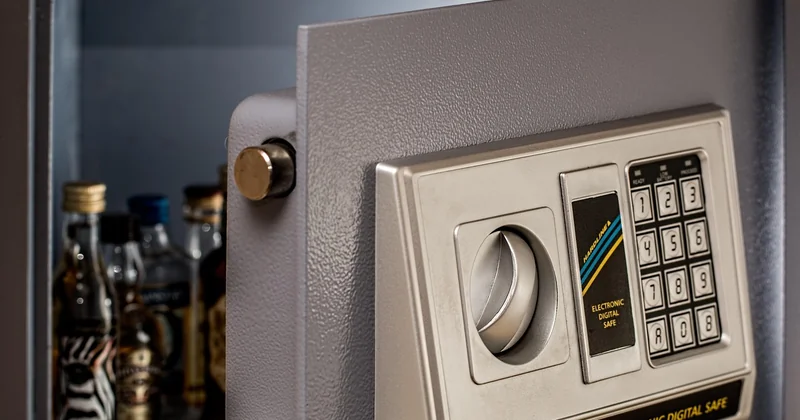
- Not in a checking account — too easy to spend, and the balance gets absorbed by routine bills.
- Not in stocks or crypto — the market can be down precisely when you need the money. This is not a place for growth, it's a place for stability.
- Not in a locked CD — penalties for early withdrawal defeat the purpose.
- Yes to a high-yield savings account — accessible, insured, and it earns something while it sits, even if that something is modest.
Government assistance programs are worth mentioning too, because people often don't know what's available. Eligibility varies enormously by state and country, and programs change. But if you're on a low income, it's worth checking whether you qualify for energy assistance, food benefits, or a tax credit you've been missing. A benefits program I'd never heard of paid a reader's entire heating bill one winter. That's real money back in your budget, and it counts toward the emergency fund in the sense that it prevents the emergency.
The part nobody says out loud
Building an emergency fund on a low income is slower than every article suggests, and that's not a personal failing. The system is designed around budgets that have slack. Yours may not, and you're still supposed to end up with a cushion.
So here's what I'd tell you: forget the $10,000. Forget nine months. Forget $27.40 a day. Set your first target at $500, automate $15 a paycheck, and let a tax refund do the heavy lifting once a year. That's not a compromise — it's the version that actually works.
The day the $1,800 repair shows up and you pay it without flinching is closer than the math makes it feel.